Introduction
When transformer monitoring generates more alarms than answers, planning stalls. By turning a flood of fleet data into a clear picture of asset health, Dynamic Ratings helped one industrial company see which of its transformers truly needed attention, and which didn’t.

The Challenge: Many Data Streams, One Decision
An industrial company operates a fleet of 60 transformers (2.5–10 MVA) across several sites. Online Dissolved Gas Analysis (DGA) monitors were providing a constant stream of data and alarms, but the data alone didn’t answer the questions that mattered most to the maintenance team: Is a fault active, stable, or already resolved? Which units need attention now, and which can wait? Should an aging transformer be repaired or replaced?
Without clear answers, every alarm looked urgent, making it difficult to plan outages, prioritize maintenance, and decide where capital spending would deliver the greatest benefit.
The Solution: Online DGA Interpretation & TAI
Dynamic Ratings assessed 11 of the 60 units, interpreting each transformer’s online DGA trends alongside electrical test results and furan-based insulation aging indicators. Rather than reacting to gas levels alone, the analysis looked at how gases were trending over time to determine whether each fault was active, stable, or historical, and classified fault types such as high-temperature thermal faults in oil (T3-H) and low-energy arcing.
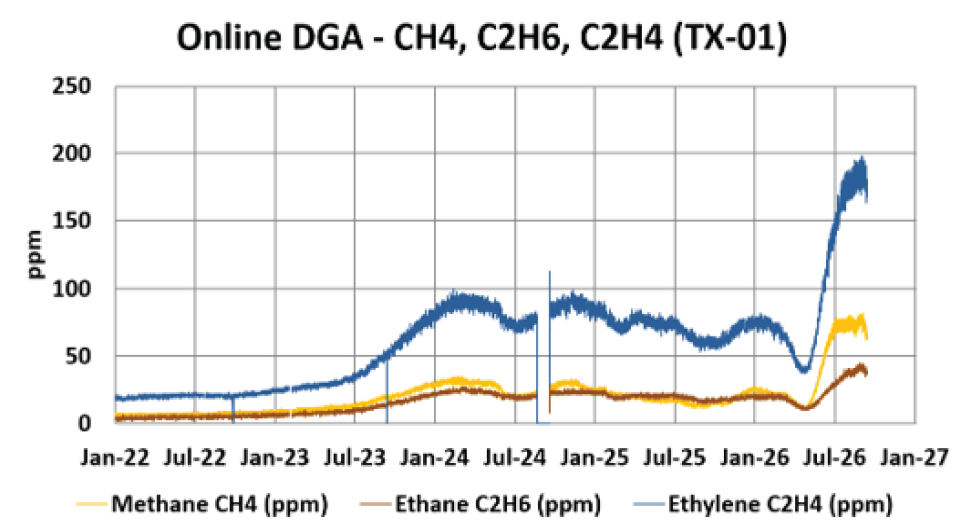
TX-01: Active T3-H Signature
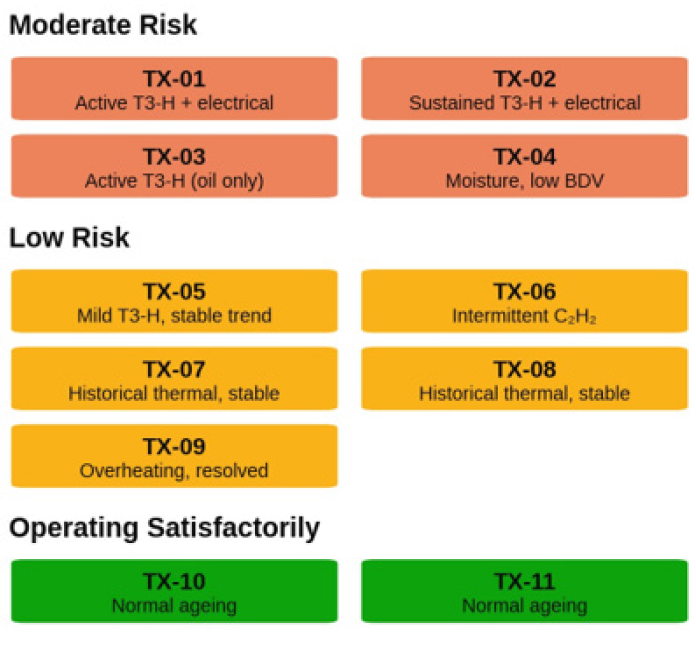
Asset-Level TAI Heat Map Classificationand Dominant Indicators
This context made a real difference. For example, TX-06 had measurable acetylene (C₂H₂), a gas that often triggers concern, but its levels stayed within the unit’s own historical baseline with no upward trend, so it was not treated as an urgent issue.
Each transformer then received a Transformer Assessment Index (TAI) score from 1 to 4: Normal Aging (1), Low Risk (2), Moderate Risk (3), or High Risk (4), giving the customer a simple, consistent way to compare units across the fleet.
*Unit serial numbers TX-01, TX-02, etc. are not the actual serial numbers.
Result: Repair First, Replace Later
The assessment gave the customer what the alarms alone couldn’t: a clear, prioritized picture of their fleet. No transformer was classified as High Risk, and none required emergency action.
Four units were rated Moderate Risk. TX-01 to TX-03 showed active or sustained high-temperature thermal faults in oil (T3-H), two with supporting electrical indicators, while TX-04 showed low estimated
breakdown voltage (BDV) based on online moisturein-oil readings. Five units were Low Risk, with stable gas trends, intermittent low-energy arcing, or historical thermal events showing no progression. The remaining two showed normal aging.
Just as importantly, the analysis showed that risk across the fleet was driven by specific defects, not by age. All 11 transformers have an estimated 70–90% of their insulation life remaining based on furan analysis, and none is near technical end of life. Duval Pentagon analysis identified the dominant fault type as T3-H, most likely caused by poor contacts or circulating currents, and the “-H” classification indicates that the paper insulation is not yet involved. That means these defects can be corrected if found early, supporting a repair-first strategy that reduces risk and defers capital replacement. Recommended areas to investigate
include tap changer connections, bushing connections, lead and bolted joints, and core grounding paths.
Each risk category was linked to a clear action: planned intervention for TX-01 to TX-03, oil remediation for TX-04, continued monitoring for Low Risk units, and routine maintenance for the rest. A detailed report for each transformer supported every recommendation.
With that clarity, the customer chose to address the Moderate Risk units during their next scheduled outage rather than taking units offline unexpectedly, while continuing to track gas trends in the meantime. Instead of reacting to alarms, they now have a plan, and a baseline to re-evaluate against at the next planned shutdown.
The value of online DGA is not finding more alarms. It is finding the few transformers that require action and knowing which ones don’t.
To learn more about DGA interpretation, visit www.dynamicratings.com/building-an-online-dga-alarm-strategy-blog/.